
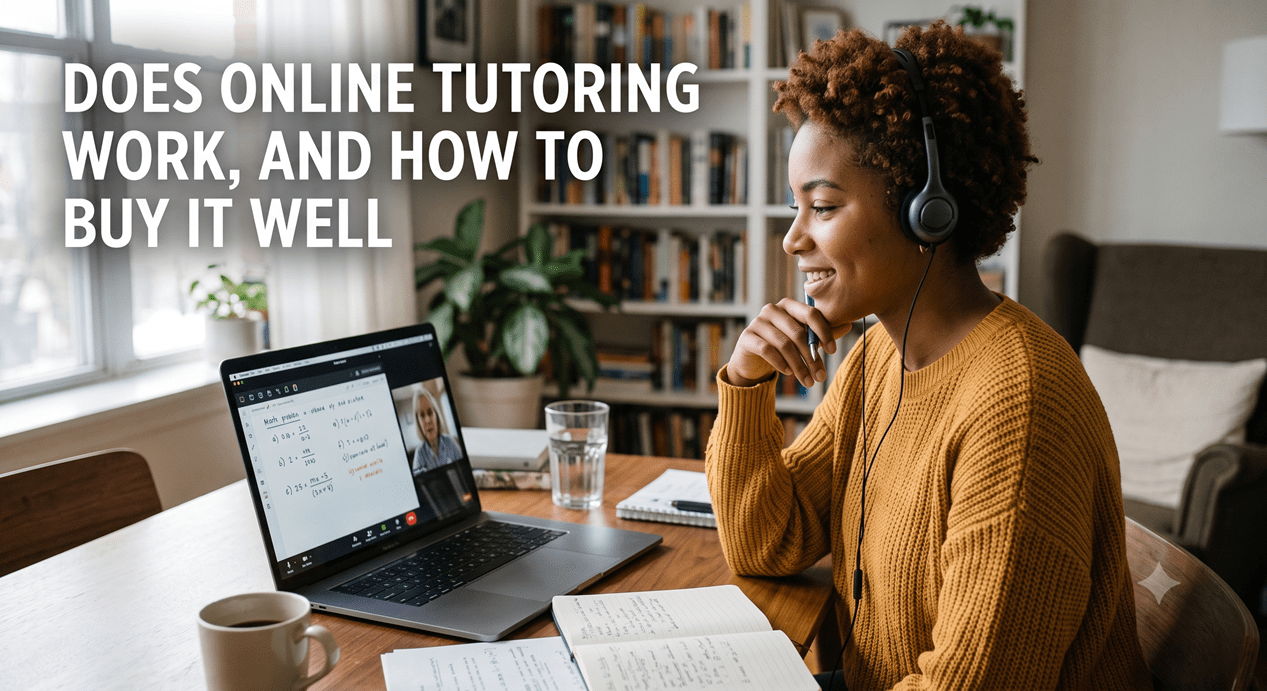
Online tutoring sells a simple promise: pick a subject, book an hour, watch the grades move. The research behind tutoring is genuinely strong, stronger than almost any other intervention parents can buy, which makes it unusual in an industry full of thin claims. The catch is that the evidence describes a specific way of doing it, and much of what gets sold looks nothing like that. Knowing the difference is worth more than any platform comparison.
What the research says about tutoring
Tutoring is one of the best studied tools in education. The Education Endowment Foundation, which maintains a running review of more than 120 studies, puts the average benefit of one to one tuition at about five additional months of progress in a year, and finds that short, regular sessions, around half an hour three to five times a week, tend to produce the best results. A large meta-analysis of randomized tutoring experiments reached a similar conclusion: consistently substantial gains, strongest when tutors are teachers or trained paraprofessionals, sessions run at least three days a week, and the tutoring connects to what happens in class.
Two details in that evidence matter for buyers. The gains come from structured programs with trained tutors and high frequency, not from occasional homework help. And the tutoring that works is tied to the student’s actual curriculum, so progress in sessions shows up in class instead of running parallel to it.
Why online tutoring often underdelivers
The typical online tutoring purchase is one hour a week with whoever was available, spent reacting to that week’s homework. That is the weakest version of what the research describes, and it explains most disappointments. Frequency is usually the missing ingredient, since practice and feedback need repetition to stick, and two or three shorter sessions beat one long one. Passivity is the other. A session where the tutor solves problems while the student watches feels productive and changes little. The student should be doing the work, wrong answers included, with the tutor diagnosing and adjusting.
Format matters less than people expect. Reviews covering digital delivery find broadly similar effects to face to face work, so a good tutor online beats a mediocre one nearby. What the screen changes is the need for structure, because it is easier for a distracted student to coast through online tutoring than through a kitchen table session. None of this makes marketplaces a bad buy. It means the buyer, not the platform, controls the variables that decide whether the money works.
How to buy online tutoring that works
- Name the gap first. “Falling behind in algebra since September” gives a tutor something to fix; “needs help with math” does not.
- Buy frequency, not length. Two or three sessions of 30 to 45 minutes a week beat a single marathon.
- Ask how the tutor will connect sessions to schoolwork, and share the syllabus or recent teacher feedback.
- Choose experience in the exact subject and level, not an impressive but unrelated CV.
- Trial before committing. Marketplaces such as Wyzant show each tutor’s hourly rate, reviews, and background up front, charge after each lesson instead of selling prepaid packages, and refund the first hour if the match does not work, which is the buying model to look for anywhere.
- Review progress every three or four weeks against real schoolwork, and change tutor without guilt if nothing moves.
What online tutoring costs
Marketplace rates in the United States commonly run from about 25 to 100 dollars an hour, with the price tracking the tutor’s credentials and the level of the subject. Small group sessions cost less per student and, according to the research, can work nearly as well as one to one when the teaching is good. Subscription platforms bundle hours at a discount, which only saves money if the hours get used. The honest math with online tutoring is monthly: two 45 minute sessions a week at a mid range rate adds up to several hundred dollars a month, so the plan needs an end condition, such as a closed gap or a finished exam season, rather than running on inertia. Free help deserves a mention before any of it: many schools run homework clubs or peer tutoring, and libraries in larger towns often host free sessions, which makes them the right first stop when money is tight.
When tutoring is the wrong fix
More instruction cannot fix a problem that is not about instruction. A student who is exhausted, skipping classes, or overwhelmed needs those causes addressed before any tutor can help, and a student who consistently struggles with reading or numbers despite real effort deserves a proper assessment rather than more drilling. Tutoring also fails when it turns into surveillance, one more scheduled hour a resentful teenager must survive. It works best as one part of a wider plan for achieving goals in school, agreed with the student rather than imposed, with sleep, attendance, and workload handled first.
Frequently asked questions
Does online tutoring work as well as in person?
The evidence suggests format matters less than quality and frequency. Reviews covering digital delivery find broadly similar effects, so well matched online tutoring generally beats a weaker local option. Younger children and easily distracted students may still do better face to face.
How much does online tutoring cost?
Commonly 25 to 100 dollars an hour on marketplaces, with specialists and test preparation above that range. Group formats and bundled hours cost less. Budget monthly and set an end condition rather than treating it as a permanent expense.
How often should tutoring sessions happen?
The research favors short and frequent: two to five sessions a week of 30 to 45 minutes during an intensive push. For steady support, twice a week is a realistic floor, and once a week helps only if the student works between sessions.
How long before tutoring shows results?
Confidence often improves within a few weeks. Measurable movement in grades usually takes a school term, since assessments lag the learning. If nothing has changed after six to eight weeks of consistent sessions, change the approach or the tutor rather than adding more of the same.